
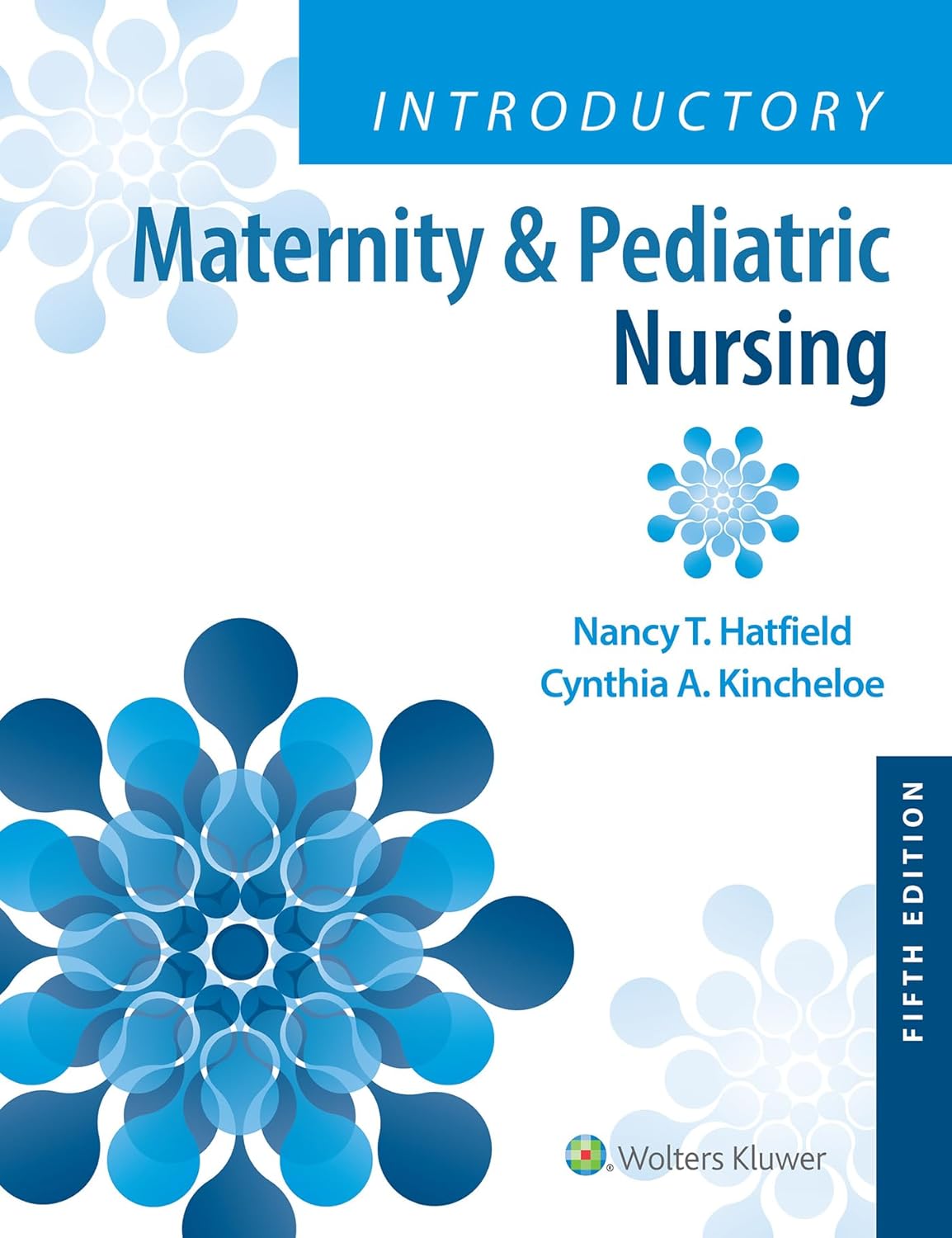
Test bank Introductory Maternity & Pediatric Nursing, 5th Edition by Nancy Hatfield
$18.00
Comprehensive NCLEX-style test bank for Introductory Maternity & Pediatric Nursing 5th Edition, covering maternity, newborn, and pediatric care with answer keys.

Description
The Introductory Maternity & Pediatric Nursing 5th Edition test bank by Nancy Hatfield is a comprehensive practice tool designed to support nursing students in mastering essential maternity, newborn, and pediatric concepts. This resource provides clinically relevant, NCLEX-style questions that reinforce safe, evidence-based nursing care across pregnancy, childbirth, postpartum care, newborn adaptation, growth and development, pediatric disorders, and family-centered care.
What This Test Bank Covers
Aligned with the full textbook, this test bank includes detailed question sets across maternity, newborn, and pediatric nursing. From reproductive health and fetal development to growth milestones, child health disorders, and complex pediatric care, students gain structured practice that strengthens clinical judgment and exam readiness.
- 40+ chapters covering maternity, newborn, growth & development, and pediatric disorders
- NCLEX-style questions that build critical-thinking and application skills
- Covers prenatal care, labor & birth, postpartum adaptation, newborn nutrition, and high-risk pregnancies
- Growth and development guidance from infancy through adolescence
- Evidence-based pediatric care across respiratory, cardiovascular, GI, endocrine, and neurologic systems
- Answer keys included for accurate and efficient self-review
- Instant digital download for easy study on any device
Why This Test Bank Helps
This resource is ideal for nursing students preparing for maternal–child course exams and NCLEX-RN/PN testing. The questions mirror real exam formats, helping learners apply assessments, prioritize interventions, understand developmental milestones, and deliver safe family-centered care.
Table of Contents
- Chapter 1: The Nurse’s Role in a Changing Maternal–Child Health Care Environment
- Chapter 2: Family-Centered and Community-Based Maternal and Pediatric Nursing
- Chapter 3: Structure and Function of the Reproductive System
- Chapter 4: Special Issues of Women’s Health Care and Reproduction
- Chapter 5: Fetal Development
- Chapter 6: Maternal Adaptation During Pregnancy
- Chapter 7: Prenatal Care
- Chapter 8: The Labor Process
- Chapter 9: Pain Management During Labor and Birth
- Chapter 10: Nursing Care During Labor and Birth
- Chapter 11: Assisted Delivery and Cesarean Birth
- Chapter 12: The Postpartum Woman
- Chapter 13: Nursing Care During Newborn Transition
- Chapter 14: Nursing Care of the Normal Newborn
- Chapter 15: Newborn Nutrition
- Chapter 16: Pregnancy at Risk: Conditions That Complicate Pregnancy
- Chapter 17: Pregnancy at Risk: Pregnancy-Related Complications
- Chapter 18: Labor at Risk
- Chapter 19: Postpartum Woman at Risk
- Chapter 20: The Newborn at Risk: Gestational and Acquired Disorders
- Chapter 21: The Newborn at Risk: Congenital Disorders
- Chapter 22: Principles of Growth and Development
- Chapter 23: Growth and Development of the Infant: 28 Days to 1 Year
- Chapter 24: Growth and Development of the Toddler: 1 to 3 Years
- Chapter 25: Growth and Development of the Preschool Child: 3 to 6 Years
- Chapter 26: Growth and Development of the School-Aged Child: 6 to 10 Years
- Chapter 27: Growth and Development of the Adolescent: 11 to 18 Years
- Chapter 28: Data Collection (Assessment) for the Child
- Chapter 29: Care of the Hospitalized Child
- Chapter 30: Procedures and Treatments
- Chapter 31: Medication Administration and Intravenous Therapy
- Chapter 32: The Child with a Chronic Health Problem
- Chapter 33: Abuse in the Family and Community
- Chapter 34: The Dying Child
- Chapter 35: The Child with a Sensory/Neurologic Disorder
- Chapter 36: The Child with a Respiratory Disorder
- Chapter 37: The Child with a Cardiovascular/Hematologic Disorder
- Chapter 38: The Child with a Gastrointestinal/Endocrine Disorder
- Chapter 39: The Child with a Genitourinary Disorder
- Chapter 40: The Child with a Musculoskeletal Disorder
- Chapter 41: The Child with an Integumentary Disorder/Communicable Disease
- Chapter 42: The Child with a Cognitive, Behavioral, or Mental Health Disorder
Sample Questions Included
- Question 1. The 6-year-old at a well-child office visit tells the nurse, “I can’t play on teams because I am not as good at doing things as my big sister is.” What suggestion should the nurse point out to the caregiver that will help increase the child’s feelings of self-confidence?
- A. Ask the child’s older siblings to compliment her more often.
- B. Praise the child for trying even when she can’t complete the same activities as the older sibling.
- C. Set up some playdates that include projects or activities in which the child can be successful.
- D. Start a rock collection with the child to show her that she can have fun doing activities that don’t involve other children.
Correct Answer: C
Rationale: School-aged children show increased interest in group activities and productive tasks. Success in age-appropriate activities helps build self-confidence and supports Erikson’s industry vs. inferiority developmental stage. Choosing activities where the child can succeed prevents feelings of inferiority and supports healthy psychosocial development.
- Question 2. The nurse is preparing a variety of projects for pediatric clients in the playroom. In deciding on activities, the nurse determines the 8-year-old will be best suited to work on which project?
- A. stack blocks in a tower
- B. build a sandcastle with a water-filled moat
- C. form vases from blocks of clay
- D. put together a model plane
Correct Answer: C
Rationale: Around age 7, children enter Piaget’s concrete operational stage. Skills such as conservation of mass and number improve, making hands-on shaping activities—like forming clay vases—appropriate and developmentally challenging. Skills like model assembly may exceed typical ability at this age, while block stacking or sand play may be too simplistic.
- Question 3. An 8-year-old boy’s foster mother is concerned about three recent cavities despite a healthy diet and fluoridated water. Which suggestion should the nurse prioritize?
- A. Encourage the child to abstain from eating sugary snacks at school.
- B. Accept that the child is genetically predisposed to more cavities than most children.
- C. Ensure that the child brushes his teeth after each meal and snacks.
- D. Have the child’s teeth professionally cleaned every 3 months.
Correct Answer: C
Rationale: Proper dental hygiene includes consistent brushing after meals and snacks. Although diet and fluoridated water help, mechanical plaque removal is essential. School-aged children should visit the dentist twice yearly, but brushing frequency is the key intervention for preventing dental caries.
FAQ
Q1: Is this test bank appropriate for maternal–child nursing course exams?
Yes. The questions follow core maternity and pediatric nursing content and support both classroom exams and NCLEX preparation.
Q2: How will I receive the test bank?
The test bank is delivered instantly as a digital download, allowing you to begin studying right away.
Related Test Banks
- Safe Maternity & Pediatric Nursing Care 3rd Edition Test Bank
- Perry Maternal Child Nursing Care Canada 3rd Edition
- Introduction to Maternity & Pediatric Nursing 9th Edition
- Maternal Child Health Nursing 9th Edition
- Maternity & Women’s Health Care 13th Edition
- Maternal Child Nursing Care 7th Edition
Start Preparing Today
Strengthen your maternity and pediatric nursing knowledge with this complete, high-quality test bank. Download instantly and boost your exam confidence now.
Only logged in customers who have purchased this product may leave a review.
Related products
-

Test Bank for Davis Advantage for Maternal-Child Nursing Care, 3rd Edition
$18.00 Add to cart -

Community/Public Health Nursing: Promoting the Health of Populations, 8th Edition Test Bank
$18.00 Add to cart -
Test Bank for Keltner’s Psychiatric Nursing, 9th Edition by Steele
$18.00 Add to cart -
Test bank for Davis Advantage for Townsend’s Essentials of Psychiatric Mental Health Nursing 9th Edition
$18.00 Add to cart


Reviews
There are no reviews yet.