


Description
Carolyn Jarvis, Annette J. Browne, June MacDonald-Jenkins, and Marian Luctkar-Flude. Get NCLEX-style health assessment questions with verified answers and concise rationales, aligned to Canadian practice
contexts. Instant-download PDF that works on phone, tablet, and desktop.
What’s Inside
- Edition-specific: Organized to the Canadian 4th Edition chapters
- Exam-style items: Multiple-choice, application/analysis, clinical scenarios
- Answers & Rationales: Included to reinforce understanding and speed review
- Access: Instant digital PDF; universal device compatibility
Table of Contents Coverage
- Critical Thinking and Evidence-Informed Assessment
- Health Promotion in the Context of Health Assessment
- A Relational Approach to Cultural and Social Considerations in Health Assessment
- The Interview
- The Complete Health History
- Mental Health Assessment
- Substance Use and Health Assessment
- Interpersonal Violence and Health Assessment
- Assessment Techniques and the Clinical Setting
- General Survey, Measurement, and Vital Signs
- Pain Assessment
- Nutritional Assessment and Nursing Practice
- Skin, Hair, and Nails
- Eyes
- Ears
- Nose, Mouth, and Throat
- Breasts and Regional Lymphatic System
- Thorax and Lungs
- Heart and Neck Vessels
- Peripheral Vascular System and Lymphatic System
- The Abdomen
- Anus, Rectum, and Prostate
- Musculo-Skeletal System
- Neurological System
- Male Genitourinary System
- Female Genitourinary System
- The Complete Health Assessment: Putting It All Together
- Bedside Assessment and Reporting
- Pregnancy
- Assessment of the Older Adult
Sample Questions — Chapter 1
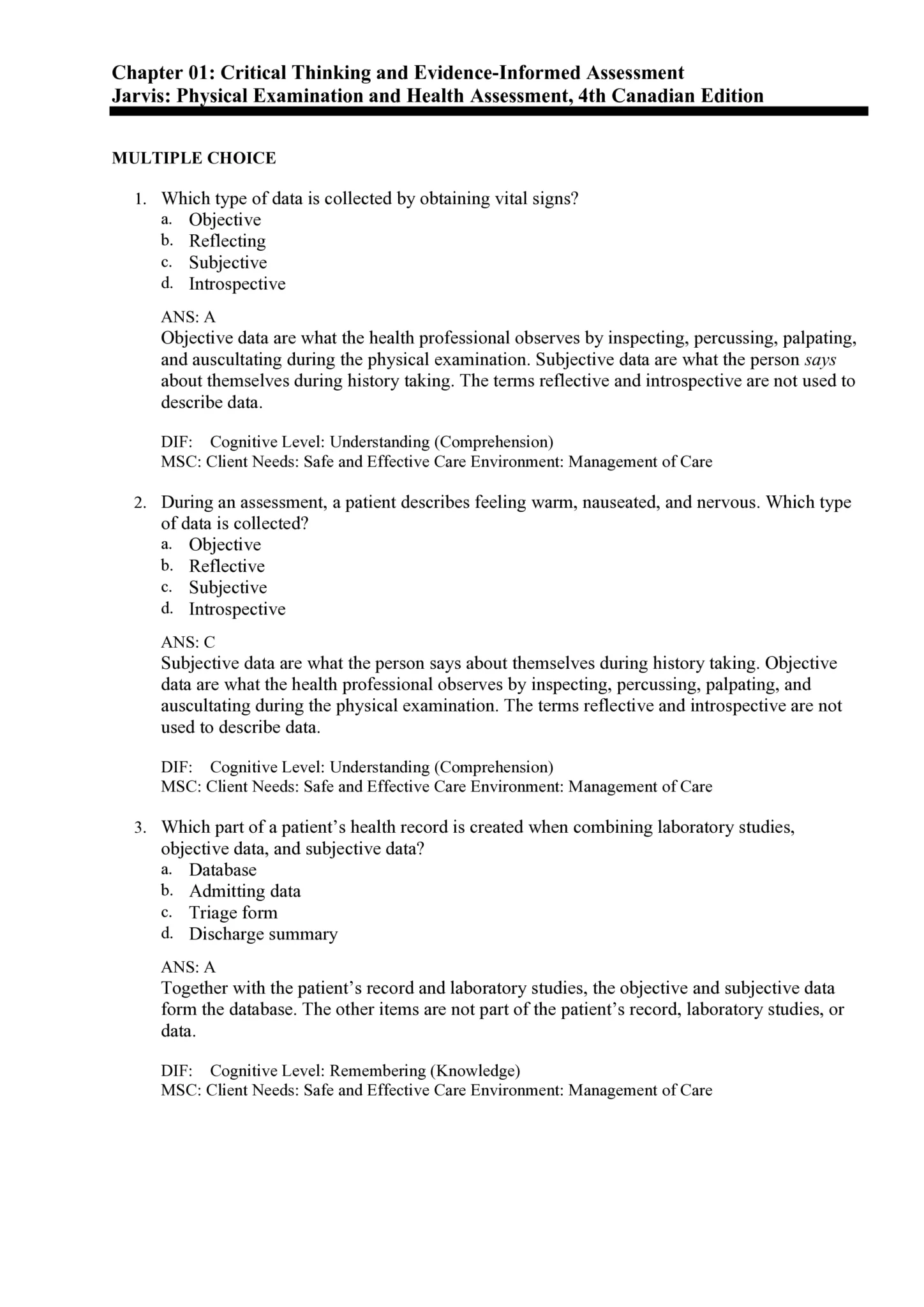
1. Which type of data is collected by obtaining vital signs?
a. Objective
b. Reflecting
c. Subjective
d. Introspective
ANS: A
Objective data are what the health professional observes by inspecting, percussing, palpating,
and auscultating during the physical examination. Subjective data are what the person says
about themselves during history taking. The terms reflective and introspective are not used to
describe data.
DIF: Cognitive Level: Understanding (Comprehension)
MSC: Client Needs: Safe and Effective Care Environment: Management of Care
2. During an assessment, a patient describes feeling warm, nauseated, and nervous. Which type
of data is collected?
a. Objective
b. Reflective
c. Subjective
d. Introspective
ANS: C
Subjective data are what the person says about themselves during history taking. Objective
data are what the health professional observes by inspecting, percussing, palpating, and
auscultating during the physical examination. The terms reflective and introspective are not
used to describe data.
DIF: Cognitive Level: Understanding (Comprehension)
MSC: Client Needs: Safe and Effective Care Environment: Management of Care
3. Which part of a patient’s health record is created when combining laboratory studies,
objective data, and subjective data?
a. Database
b. Admitting data
c. Triage form
d. Discharge summary
ANS: A
Together with the patient’s record and laboratory studies, the objective and subjective data
form the database. The other items are not part of the patient’s record, laboratory studies, or
data.
DIF: Cognitive Level: Remembering (Knowledge)
MSC: Client Needs: Safe and Effective Care Environment: Management of Care
Download & Access
-
- 📥 Instant digital download after secure checkout
- 📱 Universal PDF — phone, tablet, laptop/desktop
- 🔐 Trusted resource for Canadian health assessment courses & NCLEX prep


