
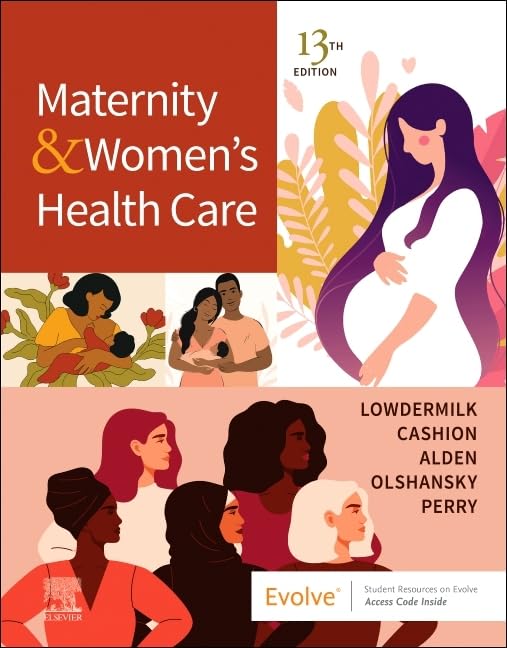
Test Bank Maternity and Women’s Health Care 13th Edition by Deitra L. Lowdermilk
$18.00
Instant PDF download of the Test Bank for Maternity and Women’s Health Care (13th Edition) by Deitra L. Lowdermilk. Exam-style nursing questions with verified answers & concise rationales—ideal for OB/maternity courses, NCLEX, ATI & HESI prep.

Description
Why Choose This maternity nursing test bank?
- Edition-specific: Aligned with the 13th Edition of Maternity and Women’s Health Care
- Question formats: Multiple-choice, application, and clinical scenarios
- Answers & Rationales: Verified responses with explanations for fast review
- Digital convenience: PDF download, study on any device
Table of Contents Coverage
- 21st Century Maternity and Women’s Health Nursing
- Community Care: The Family and Culture
- Nursing and Genomics
- Assessment and Health Promotion
- Violence Against Women
- Reproductive System Concerns
- Sexually Transmitted and Other Infections
- Contraception and Abortion
- Infertility
- Problems of the Breast
- Structural Disorders and Neoplasms of the Reproductive System
- Conception and Fetal Development
- Anatomy and Physiology of Pregnancy
- Nursing Care of the Family During Pregnancy
- Maternal Nutrition
- Labor and Birth Processes
- Maximizing Comfort for the Laboring Woman
- Fetal Assessment During Labor
- Nursing Care of the Family During Labor and Birth
- Postpartum Physiologic Changes
- Nursing Care of the Family During the Postpartum Period
- Transition to Parenthood
- Physiologic and Behavioral Adaptations of the Newborn
- Nursing Care of the Newborn and Family
- Newborn Nutrition and Feeding
- Assessment of High Risk Pregnancy
- Hypertensive Disorders
- Hemorrhagic Disorders
- Endocrine and Metabolic Disorders
- Medical-Surgical Disorders
- Mental Health Disorders and Substance Abuse
- Labor and Birth Complications
- Postpartum Complications
- Nursing Care of the High-Risk Newborn
- Acquired Problems of the Newborn
- Hemolytic Disorders and Congenital Anomalies
- Perinatal Loss, Bereavement, and Grief
Sample Questions — Chapter 1: 21st Century Maternity Nursing
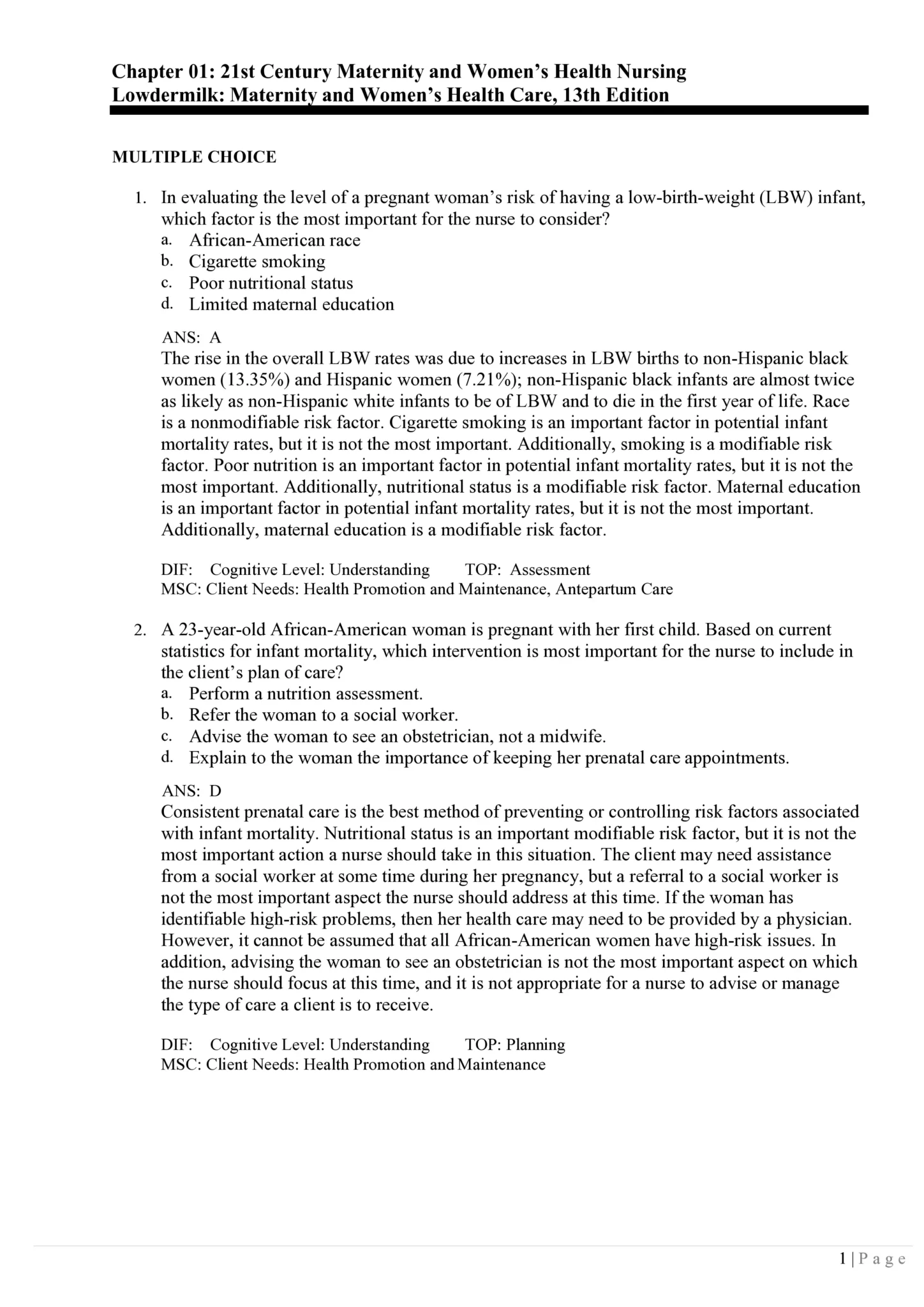
1. In evaluating the level of a pregnant woman’s risk of having a low-birth-weight (LBW) infant, which factor is the most important for the nurse to consider?:
- a. African-American race.
- b. Cigarette smoking.
- c. Poor nutritional status.
- d. Limited maternal education.
Answer: A
The rise in the overall LBW rates was due to increases in LBW births to non-Hispanic black women (13.35%) and Hispanic women (7.21%); non-Hispanic black infants are almost twice as likely as non-Hispanic white infants to be of LBW and to die in the first year of life. Race is a nonmodifiable risk factor. Cigarette smoking is an important factor in potential infant mortality rates, but it is not the most important. Additionally, smoking is a modifiable risk factor. Poor nutrition is an important factor in potential infant mortality rates, but it is not the most important. Additionally, nutritional status is a modifiable risk factor. Maternal education
is an important factor in potential infant mortality rates, but it is not the most important. Additionally, maternal education is a modifiable risk factor.
DIF: Cognitive Level: Understanding TOP: Assessment
MSC: Client Needs: Health Promotion and Maintenance, Antepartum Care
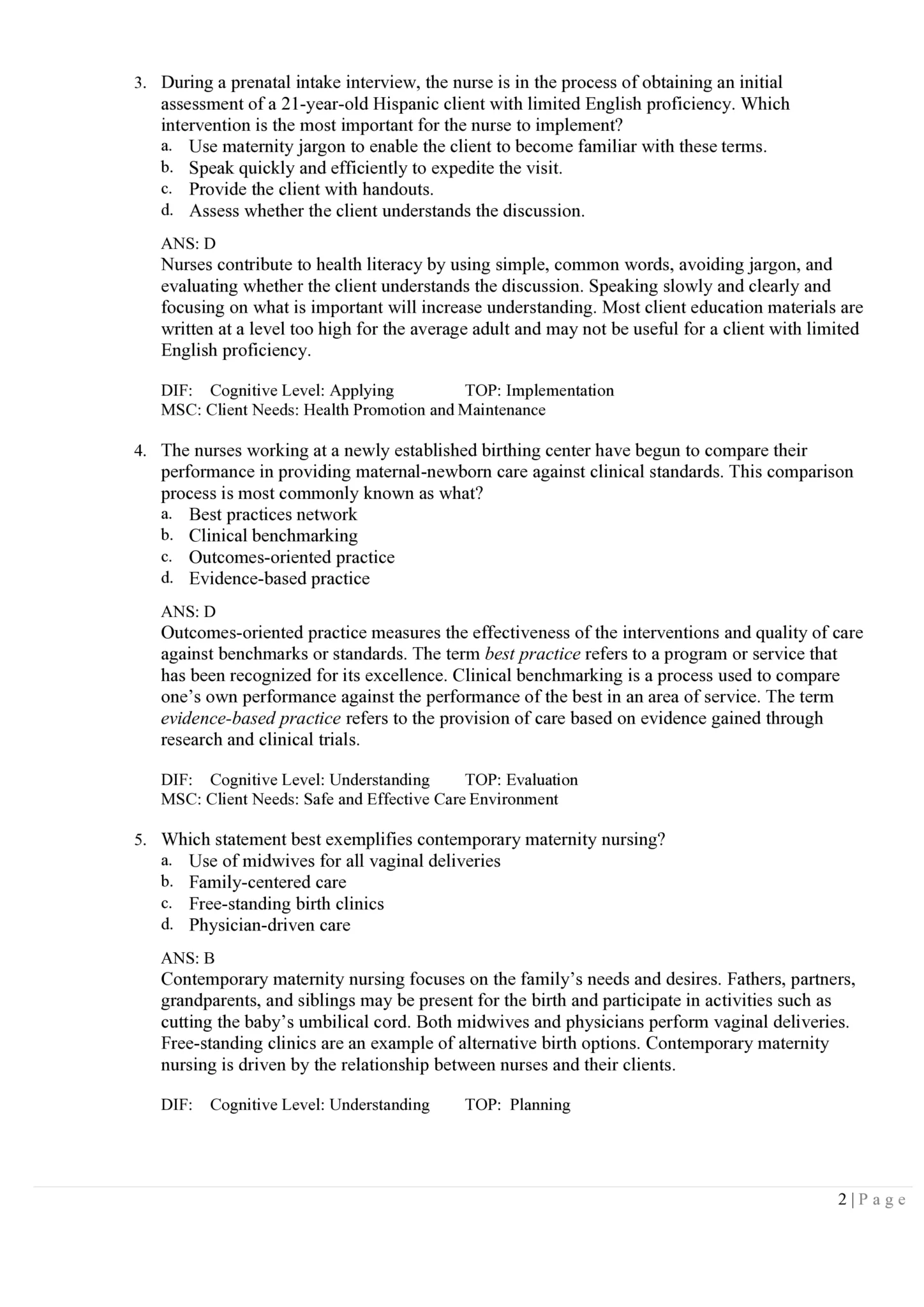
2. During a prenatal intake interview, the nurse is in the process of obtaining an initial assessment of a 21-year-old Hispanic client with limited English proficiency. Which intervention is the most important for the nurse to implement?
- a. Use maternity jargon to enable the client to become familiar with these terms.
- b. Speak quickly and efficiently to expedite the visit.
- c. Provide the client with handouts.
- d. Assess whether the client understands the discussion.
Answer: D
Nurses contribute to health literacy by using simple, common words, avoiding jargon, and evaluating whether the client understands the discussion. Speaking slowly and clearly and focusing on what is important will increase understanding. Most client education materials are written at a level too high for the average adult and may not be useful for a client with limited
English proficiency.
DIF: Cognitive Level: Applying TOP: Implementation
MSC: Client Needs: Health Promotion and Maintenance
FAQs — Maternity & Women’s Health Care (13th Edition)
Is this test bank aligned with Lowdermilk’s 13th Edition?
Yes. The questions follow the chapters of the 13th Edition of Maternity and Women’s Health Care.
Do questions include rationales?
Yes. Each question has a verified answer, and many include concise rationales for deeper learning.
How will I receive the file?
Delivery is instant. You’ll get a secure PDF download link on the confirmation page, in your email receipt, and inside your account dashboard.
Can I use it on my phone or tablet?
Yes. The PDF is universal and works on iOS, Android, Windows, and macOS.
Download & Access
- Instant digital download
- Study on any device
- Trusted resource for OB/maternity nursing success
Share your thoughts!
Let us know what you think...
Only logged in customers who have purchased this product may leave a review. Log in now
Related products
-

Wong’s Nursing Care of Infants and Children 12th Edition Test Bank PDF
$18.00 Add to cart -

Community/Public Health Nursing: Promoting the Health of Populations, 8th Edition Test Bank
$18.00 Add to cart -
Test Bank for Leadership Roles and Management Functions in Nursing, 11th Edition
$18.00 Add to cart -
Test bank for Davis Advantage for Townsend’s Psychiatric Mental Health Nursing 11th Edition
$18.00 Add to cart


What others are saying
There are no contributions yet.