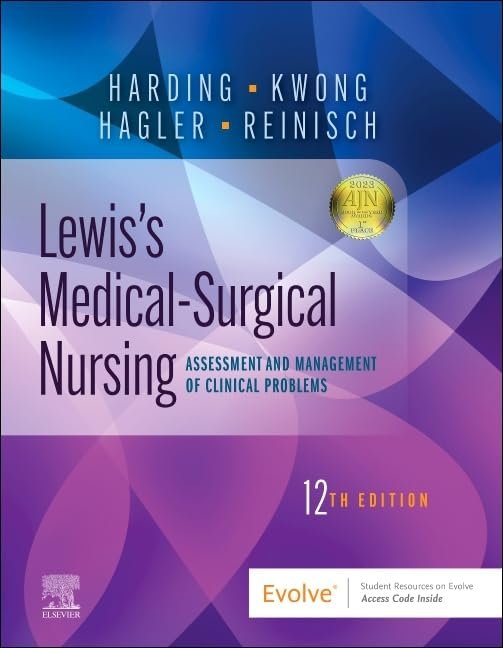
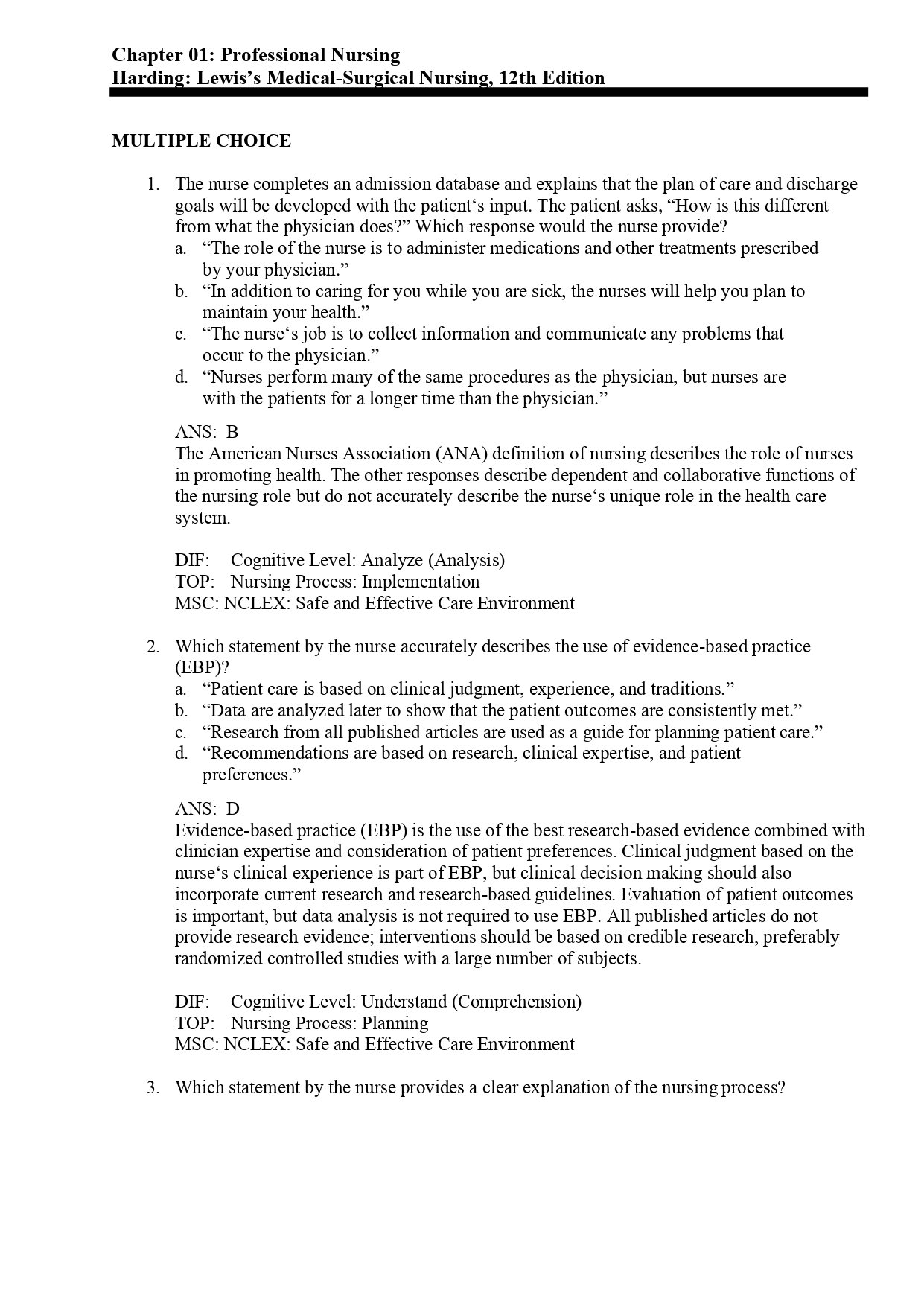
Test Bank for Lewis’s Medical-Surgical Nursing: Assessment and Management of Clinical Problems, 12th Edition
$23.00 Original price was: $23.00.$18.00Current price is: $18.00.
Lewis’s Medical-Surgical Nursing: 12th Edition – Test Bank (Harding)
- ✅ Instant PDF download after purchase
- ✅ NCLEX®, ATI®, HESI®-style questions with detailed rationales
- ✅ Chapter-by-chapter coverage of the 12th edition
Boost your Med–Surg exam scores and prepare with confidence.

Description
The lewis medical surgical nursing 12th edition test bank is a comprehensive question bank designed to help nursing students master assessment and management of complex clinical problems across all major body systems. Aligned with Lewis’s Medical-Surgical Nursing: Assessment and Management of Clinical Problems, 12th Edition, it provides scenario-based, NCLEX-style items that strengthen critical thinking, prioritization, and clinical judgment for adult medical-surgical care.
What This Test Bank Covers
This test bank follows the full textbook structure from foundational professional nursing concepts to advanced system-focused care. Chapters include professional nursing, social determinants of health, chronic illness and older adults, emergency and disaster nursing, respiratory and cardiovascular care, renal and endocrine problems, neurologic disorders, musculoskeletal trauma, and more.
- Extensive chapter coverage across assessment, pathophysiology, and nursing management of clinical problems
- NCLEX-style multiple-choice questions that mirror real exam formats and clinical decision making
- Focus on assessment, interventions, and evaluation for acute and chronic conditions
- Includes complex topics like shock, sepsis, ARDS, acute kidney injury, stroke, dementia, and endocrine emergencies
- Supports learning in ventilatory support, hemodynamics, and multi-organ dysfunction
- Answer key included for self-testing and remediation
- Ideal for course exams, HESI/ATI-style testing, and NCLEX preparation
- Instant digital access for flexible study on laptop or tablet
Why This Test Bank Helps
Medical-surgical nursing is content-heavy and clinically demanding. This test bank helps you move beyond memorization by applying concepts such as fluid and electrolyte balance, respiratory support, cardiovascular assessment, renal function, neurologic status, and endocrine regulation to realistic patient scenarios. It is especially useful when used alongside class notes, clinical experiences, and the main Lewis text to improve confidence and exam performance.
Table of Contents for Lewis’s Medical-Surgical Nursing 12th Edition
- Chapter 01: Professional Nursing
- Chapter 02: Social Determinants of Health
- Chapter 03: Health History and Physical Examination
- Chapter 04: Patient and Caregiver Teaching
- Chapter 05: Chronic Illness and Older Adults
- Chapter 06: Caring for Lesbian, Gay, Bisexual, Transgender, Queer or Questioning, and Gender Diverse Patients
- Chapter 07: Stress Management
- Chapter 08: Sleep and Sleep Disorders
- Chapter 09: Pain
- Chapter 10: Palliative and End-of-Life Care
- Chapter 11: Substance Use Disorders in Acute Care
- Chapter 12: Inflammation and Healing
- Chapter 13: Genetics
- Chapter 14: Immune Responses and Transplantation
- Chapter 15: Infection
- Chapter 16: Cancer
- Chapter 17: Fluid, Electrolyte, and Acid-Base Imbalances
- Chapter 18: Preoperative Care
- Chapter 19: Intraoperative Care
- Chapter 20: Postoperative Care
- Chapter 21: Emergency and Disaster Nursing
- Chapter 22: Assessment and Management: Visual Problems
- Chapter 23: Assessment and Management: Auditory Problems
- Chapter 24: Assessment: Integumentary System
- Chapter 25: Integumentary Problems
- Chapter 26: Burns
- Chapter 27: Assessment: Respiratory System
- Chapter 28: Supporting Ventilation
- Chapter 29: Upper Respiratory Problems
- Chapter 30: Lower Respiratory Problems
- Chapter 31: Obstructive Pulmonary Diseases
- Chapter 32: Acute Respiratory Failure and Acute Respiratory Distress Syndrome
- Chapter 33: Assessment: Hematologic System
- Chapter 34: Hematologic Problems
- Chapter 35: Assessment: Cardiovascular System
- Chapter 36: Hypertension
- Chapter 37: Coronary Artery Disease and Acute Coronary Syndrome
- Chapter 38: Heart Failure
- Chapter 39: Dysrhythmias
- Chapter 41: Vascular Disorders
- Chapter 42: Shock, Sepsis, and Multiple Organ Dysfunction Syndrome
- Chapter 44: Nutrition Problems
- Chapter 45: Obesity
- Chapter 46: Upper Gastrointestinal Problems
- Chapter 47: Lower Gastrointestinal Problems
- Chapter 49: Assessment: Urinary System
- Chapter 50: Renal and Urologic Problems
- Chapter 51: Acute Kidney Injury and Chronic Kidney Disease
- Chapter 52: Assessment: Endocrine System
- Chapter 53: Diabetes
- Chapter 54: Endocrine Problems
- Chapter 55: Assessment: Reproductive System
- Chapter 56: Breast Problems
- Chapter 57: Sexually Transmitted Infections
- Chapter 58: Female Reproductive Problems
- Chapter 59: Male Reproductive Problems
- Chapter 60: Assessment: Nervous System
- Chapter 61: Acute Intracranial Problems
- Chapter 62: Stroke
- Chapter 63: Chronic Neurologic Problems
- Chapter 64: Dementia and Delirium
- Chapter 66: Assessment: Musculoskeletal System
- Chapter 67: Musculoskeletal Trauma and Orthopedic Surgery
- Chapter 68: Musculoskeletal Problems
Sample Question Themes
- Question 1. Which action would the nurse take to verify the correct placement of an oral endotracheal (ET) tube immediately after insertion and before securing the tube?
- a. Obtain a portable chest x-ray.
- b. Use an end-tidal CO2 monitor.
- c. Auscultate for bilateral breath sounds.
- d. Observe for symmetrical chest movement.
Correct Answer: b. Use an end-tidal CO2 monitor.
Rationale: End-tidal CO2 monitoring is recommended for rapid verification of ET tube placement. Chest movement and breath sounds are helpful but less reliable, and a chest x-ray is used after the tube is secured, not as the immediate check.
- Question 2. Which action would the nurse take to maintain proper endotracheal tube (ET) cuff pressure when a patient is on mechanical ventilation?
- a. Inflate the cuff with a minimum of 10 mL of air.
- b. Inflate the cuff until the pilot balloon is firm on palpation.
- c. Inject air into the cuff until a manometer shows 15 mm Hg pressure.
- d. Inject air into the cuff until a slight leak is heard only at peak inflation.
Correct Answer: d. Inject air into the cuff until a slight leak is heard only at peak inflation.
Rationale: The minimal occluding volume technique uses just enough air to eliminate leaks except at peak inspiration, helping maintain appropriate cuff pressure (typically 20–30 mm Hg) and reducing the risk of tracheal injury or aspiration.
- Question 3. The nurse notes premature ventricular contractions (PVCs) on the monitor while suctioning a patient’s endotracheal tube. Which action would the nurse take?
- a. Plan to suction the patient more frequently.
- b. Decrease the suction pressure to 80 mm Hg.
- c. Give antidysrhythmic medications per protocol.
- d. Ventilate the patient with 100% oxygen.
Correct Answer: d. Ventilate the patient with 100% oxygen.
Rationale: Dysrhythmias during suctioning often indicate hypoxemia or sympathetic stimulation. The priority is to stop suctioning and ventilate with 100% oxygen. Medications are considered only if dysrhythmias persist after oxygenation is optimized.
Who Is This Test Bank For?
This resource is ideal for:
- Pre-licensure nursing students in medical-surgical courses
- Internationally educated nurses preparing for licensing exams
- Students using Lewis’s text as a primary med-surg reference
- Learners who want more practice with higher-level application and analysis questions
RelatedMedical-Surgical Nursing Test Banks
- Lewis’s Medical-Surgical Nursing 12th Edition Test Bank
- Lewis’s Medical-Surgical Nursing in Canada 5th Edition Test Bank
- Brunner & Suddarth’s Medical-Surgical Nursing 15th Edition Test Bank
- Brunner & Suddarth Canadian Medical-Surgical Nursing 4th Edition Test Bank
- Medical-Surgical Nursing: Concepts & Practice 5th Edition Test Bank
- Timby’s Introductory Medical-Surgical Nursing 13th Edition Test Bank
FAQ
Q1: Does this test bank match the 12th Edition of Lewis’s Medical-Surgical Nursing?
Yes. The test bank is organized by chapter to correspond with Lewis’s Medical-Surgical Nursing: Assessment and Management of Clinical Problems, 12th Edition, covering professional nursing, system assessments, and management of clinical problems across all major body systems.
Q2: Can I use this test bank to prepare for NCLEX?
This test bank is designed primarily for course and unit exams, but its NCLEX-style questions and emphasis on prioritization, safety, and clinical judgment also support NCLEX-RN preparation when combined with a comprehensive NCLEX review plan.
Start Practicing Today
Strengthen your medical-surgical nursing knowledge, refine your critical thinking, and feel more confident in managing complex adult patients. Download the Lewis’s Medical-Surgical Nursing 12th Edition test bank now and start preparing for your next exam.
Related products
-
Sale!
Timby’s Introductory Medical-Surgical Nursing 13th Edition Test Bank
0 - 0 reviews$26.00Original price was: $26.00.$18.00Current price is: $18.00. Add to cart -
Sale!

Test Bank for Mental Health Nursing, 6th Edition (Gorman & Anwar)
0 - 0 reviews$26.00Original price was: $26.00.$23.00Current price is: $23.00. Add to cart -
Sale!
Test Bank for Discovering the Life Span, 5th Edition by Robert S. Feldman
0 - 0 reviews$26.00Original price was: $26.00.$23.00Current price is: $23.00. Add to cart -
Sale!
Test Bank for Medical-Surgical Nursing: Concepts and Practice, 8th Edition
0 - 0 reviews$26.00Original price was: $26.00.$17.00Current price is: $17.00. Add to cart