
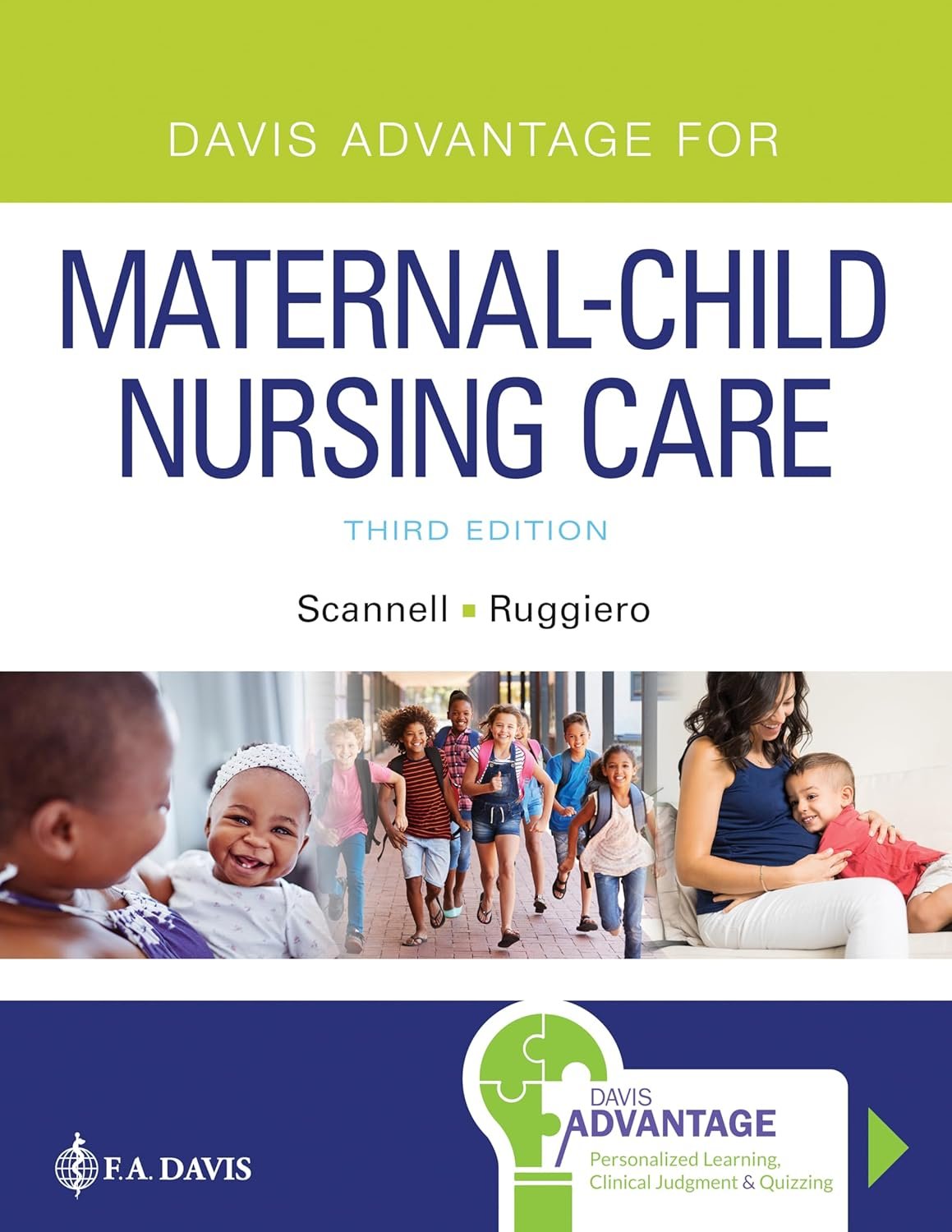
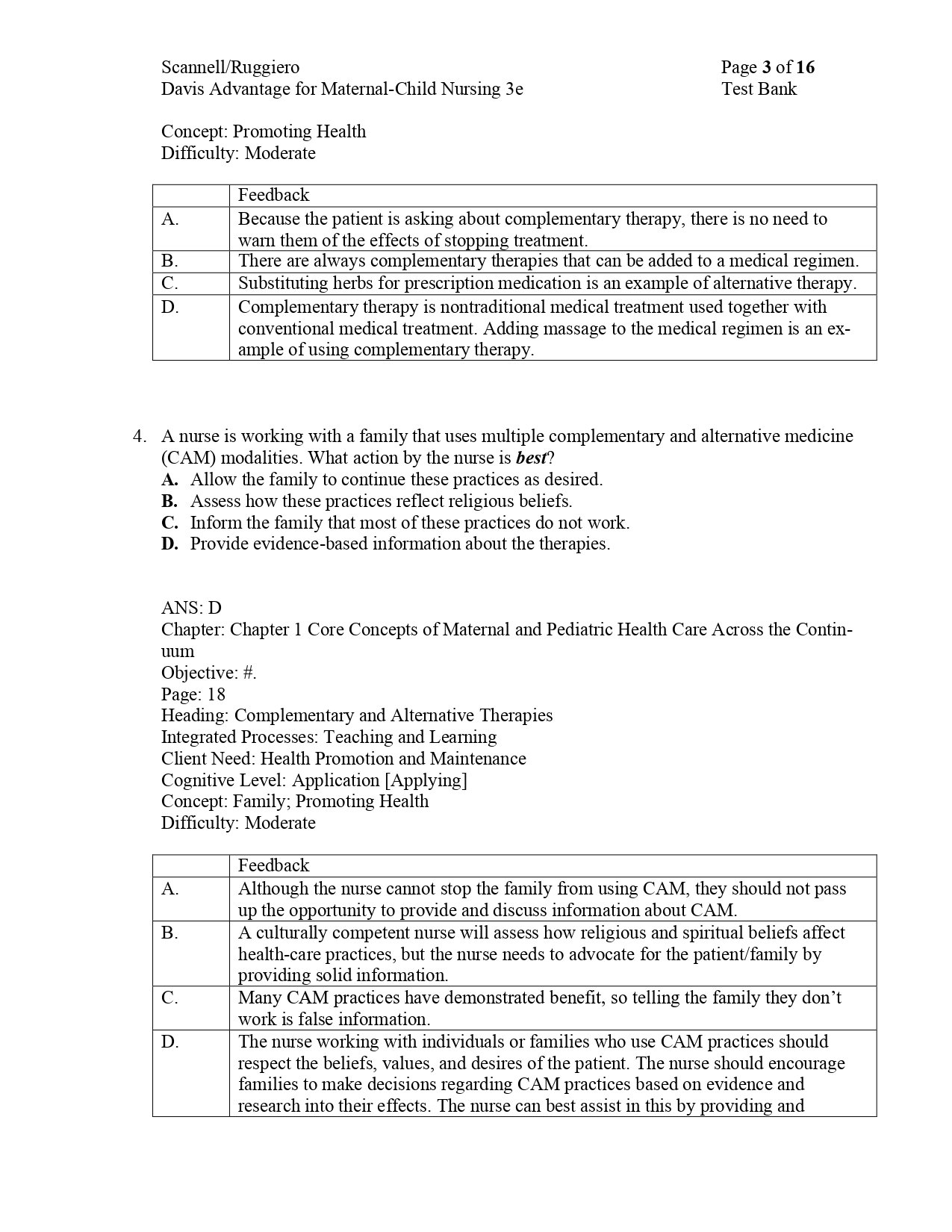
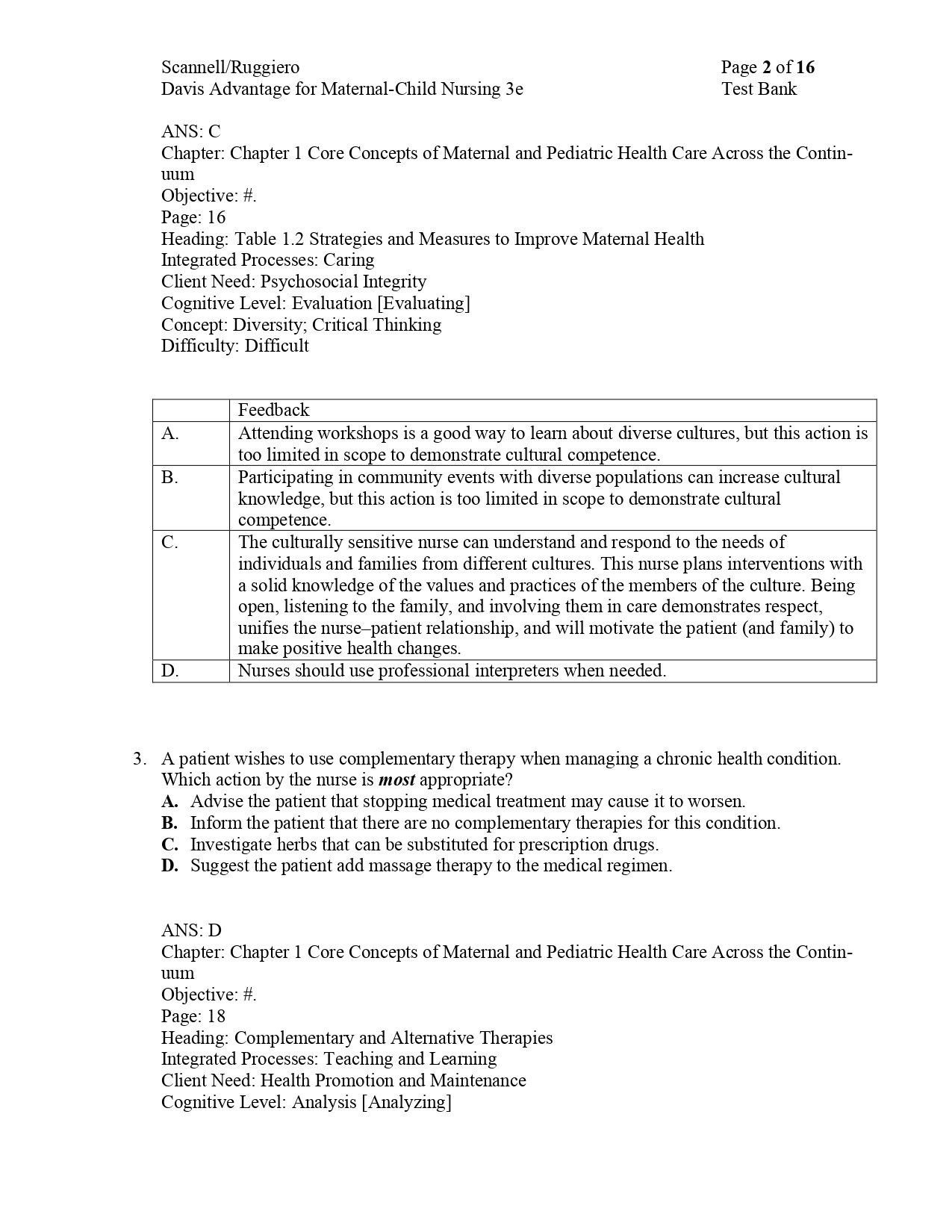
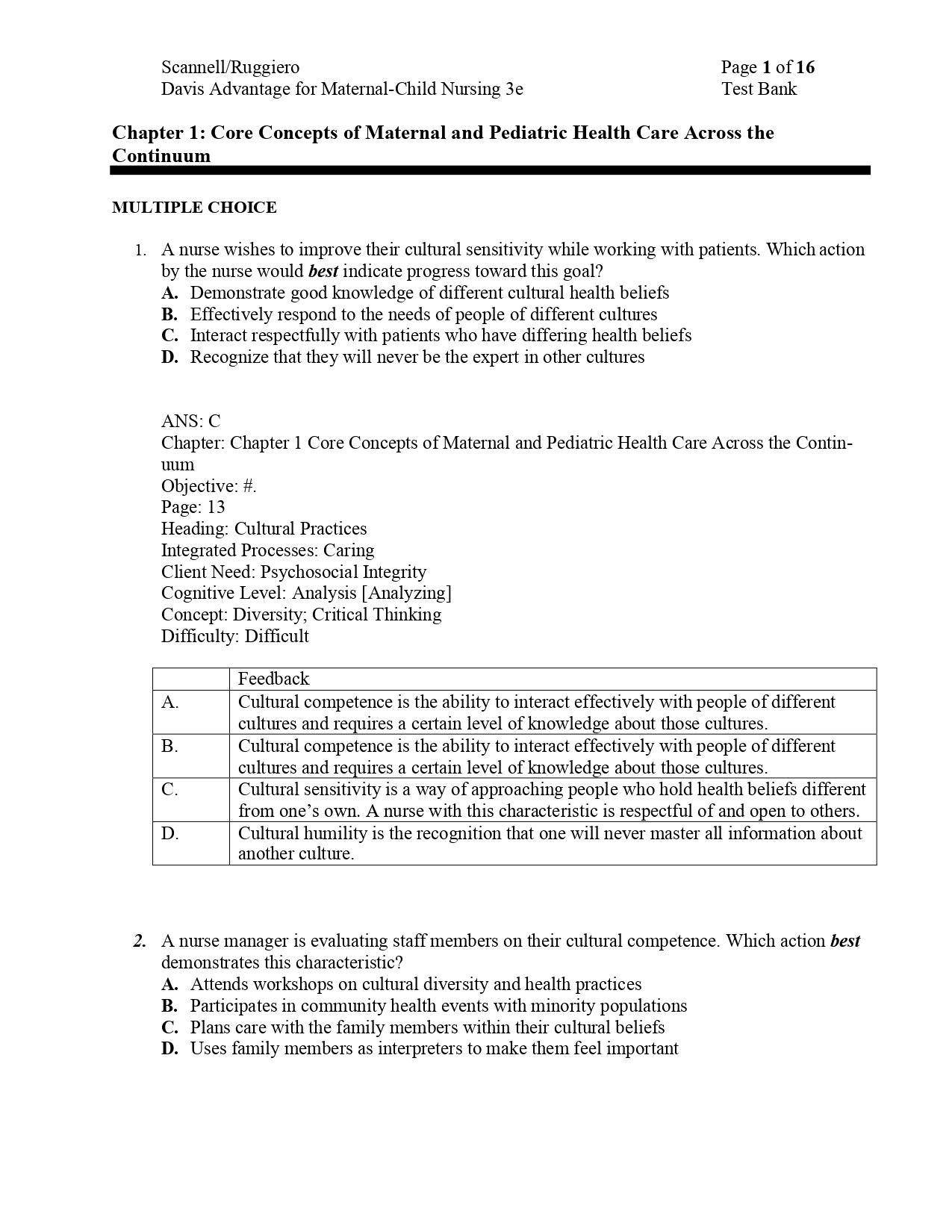
Test Bank for Davis Advantage for Maternal-Child Nursing Care, 3rd Edition
$18.00
Instant-access digital test bank for Davis Advantage for Maternal-Child Nursing Care, 3rd Edition. Includes NCLEX-style questions, rationales, and comprehensive maternal, newborn, and pediatric content for strong exam preparation.

Description
Overview
The davis advantage for maternal-child nursing care 3rd edition test bank offers a complete and high-quality collection of exam-style questions aligned with Susan Scott Ricci & Terri Kyle’s widely used textbook. This comprehensive digital resource helps students strengthen clinical judgment across maternal, newborn, pediatric, and women’s health concepts while supporting instructors with ready-to-use assessments.
The test bank includes hundreds of chapter-organized questions with detailed rationales that reflect current course objectives, NCLEX-style formats, and real-world clinical decision-making. Whether preparing for weekly quizzes, unit exams, or the NCLEX, this resource provides accurate, evidence-based practice to build confidence and mastery.
Key Features & Benefits
- Fully aligned with Davis Advantage for Maternal-Child Nursing Care, 3rd Edition (Ricci & Kyle).
- NCLEX-style and NGN-style items that strengthen clinical judgment in maternal, newborn, and pediatric care.
- Chapter-organized structure for easier studying, lesson planning, and targeted review.
- Accurate answer keys with rationales explaining the “why” behind correct and incorrect choices.
- Instant digital download available immediately after purchase.
- Ideal for instructors creating exams, quizzes, or remediation plans.
- Ideal for students practicing clinical reasoning and exam readiness.
- Improves NCLEX outcomes by reinforcing priority-setting, safety, and evidence-based maternal-child care.
Full Table of Contents
- I. Foundations in the Nursing Care of Maternal, Family, and Child Care
- 1. Core Concepts of Maternal and Pediatric Healthcare Across the Continuum
- II. The Process of Human Reproduction
- 2. Reproduction
- 3. Conception and Development of the Embryo and Fetus
- III. The Prenatal Journey
- 4. Physiological and Psychosocial Changes During Pregnancy
- 5. Promoting a Healthy Pregnancy
- 6. Caring for the Woman Experiencing Complications During Pregnancy
- IV. The Birth Experience
- 7. The Process of Labor and Birth
- 8. Caring for the Woman Experiencing Complications During Labor and Birth
- V. Care of the New Family
- 9. Physiological Transition of the Newborn
- 10. Caring for the Newborn at Risk
- 11. Caring for the Postpartal Woman and Her Family
- 12. Caring for the Woman Experiencing Complications During the Postpartal Period
- VI. Foundations in Nursing Care of Children
- 13. Caring for the Developing Child
- 14. Developmentally Appropriate Nursing Care Across Care Settings
- 15–27. Caring for the Child with Respiratory, GI, Cardiovascular, Immunological, Endocrine, Neurological, Musculoskeletal, Integumentary, GU, Hematologic, Psychosocial, or Cancer Conditions; Chronic Conditions and End-of-Life Care
- VII. Promotion of Women’s and Families’ Health
- 28. Promoting the Safety of Women and Families
- 29. Promoting Premenstrual, Perimenopausal, and Menopausal Health
- 30. Promoting Breast Health
- 31. Gynecological Disorders
- 32. Sexually Transmitted Diseases
- 33. Common Reproductive Cancers
Sample Questions – Chapter 33: Promoting Reproductive Health: Common Reproductive Cancers
1. A patient appears upset after her visit with the gynecologist because she believes that she has cancer. The nurse reviews the physician’s notes from the office visit that indicates that there is metaplasia. What is the best nursing response?
- A. Make a referral for the patient to see an oncologist.
- B. Ask the patient how long she has been having symptoms.
- C. Reassure the patient that this is a normal process of cellular growth.
- D. Check that the patient has made a follow-up appointment to discuss findings with the physician.
Answer: C
Rationale: Metaplasia denotes normal cellular turnover during adolescence and pregnancy. The nurse should recognize normal versus abnormal cervical findings.
2. A group of nursing students are reviewing female anatomy of the cervix. Which area would be most susceptible to cancer growths?
- A. Vaginal portion of the cervix
- B. Ectocervix
- C. Internal cervical os
- D. Transformation zone
Answer: D
Rationale: The transformation zone undergoes rapid cellular change, making it the most susceptible area for premalignant or malignant transformation.
3. A 30-year-old female presents to the gynecologist office for a wellness checkup. What tests does the nurse anticipate that the health-care provider will perform?
- A. Urinalysis, CBC with differential, and Pap test
- B. Pregnancy test, urinalysis, Pap and HPV tests
- C. RPR, Pap and HPV tests
- D. CBC, Chemistry, urinalysis, and pregnancy test
Answer: B
Rationale: Current cervical cancer screening recommendations support combined Pap and HPV testing. A pregnancy test and urinalysis are routine components of a wellness visit.
How This Test Bank Supports NCLEX Success
Students strengthen clinical reasoning across maternal, newborn, pediatric, and reproductive health scenarios. With detailed rationales and NGN-style questions, this resource helps learners build safety-focused decision-making and confidently prepare for exams.
FAQ
Q1: Is this the full test bank used by instructors?
A: Yes. This is the official-style test bank aligned with the 3rd edition textbook, ideal for exam preparation and concept reinforcement.
Q2: How fast will I receive my test bank?
A: Delivery is instant. After checkout, your files are available immediately for download.
Related Test Banks (Full Links)
- Davis Advantage Pediatric Nursing: Critical Components 3rd Edition Test Bank
- Safe Maternity & Pediatric Nursing Care 3rd Edition Test Bank
- Perry Maternal-Child Nursing Care (Canada) 3rd Edition Test Bank
- Introduction to Maternity & Pediatric Nursing 9th Edition Test Bank
- Maternal-Child Nursing Care 7th Edition Test Bank
- Maternity & Women’s Health Care 13th Edition Test Bank
Call to Action
Download instantly and start preparing today. Add the Davis Advantage for Maternal-Child Nursing Care 3rd Edition Test Bank to your cart to access reliable, high-quality questions that reinforce maternal, newborn, and pediatric nursing success.
Related products
-

Test bank for Foundations of Mental Health Care 8th Edition | Exambase
$18.00 Add to cart -

Test Bank for Mental Health Nursing, 6th Edition (Gorman & Anwar)
$18.00 Add to cart -
Test Bank for Huether & McCance’s Understanding Pathophysiology, 2nd Canadian Edition
$18.00 Add to cart -
Understanding Nursing Research 8th Edition Test Bank (Grove & Gray)
$18.00 Add to cart


